
Request a Site Survey Send an Enquiry
No obligation. Just tell us about your building and we’ll be in touch.
IPAF · PASMA · CSCS · CITB · KeeLine, Kingspan, Euroclad and Alwitra approved installer
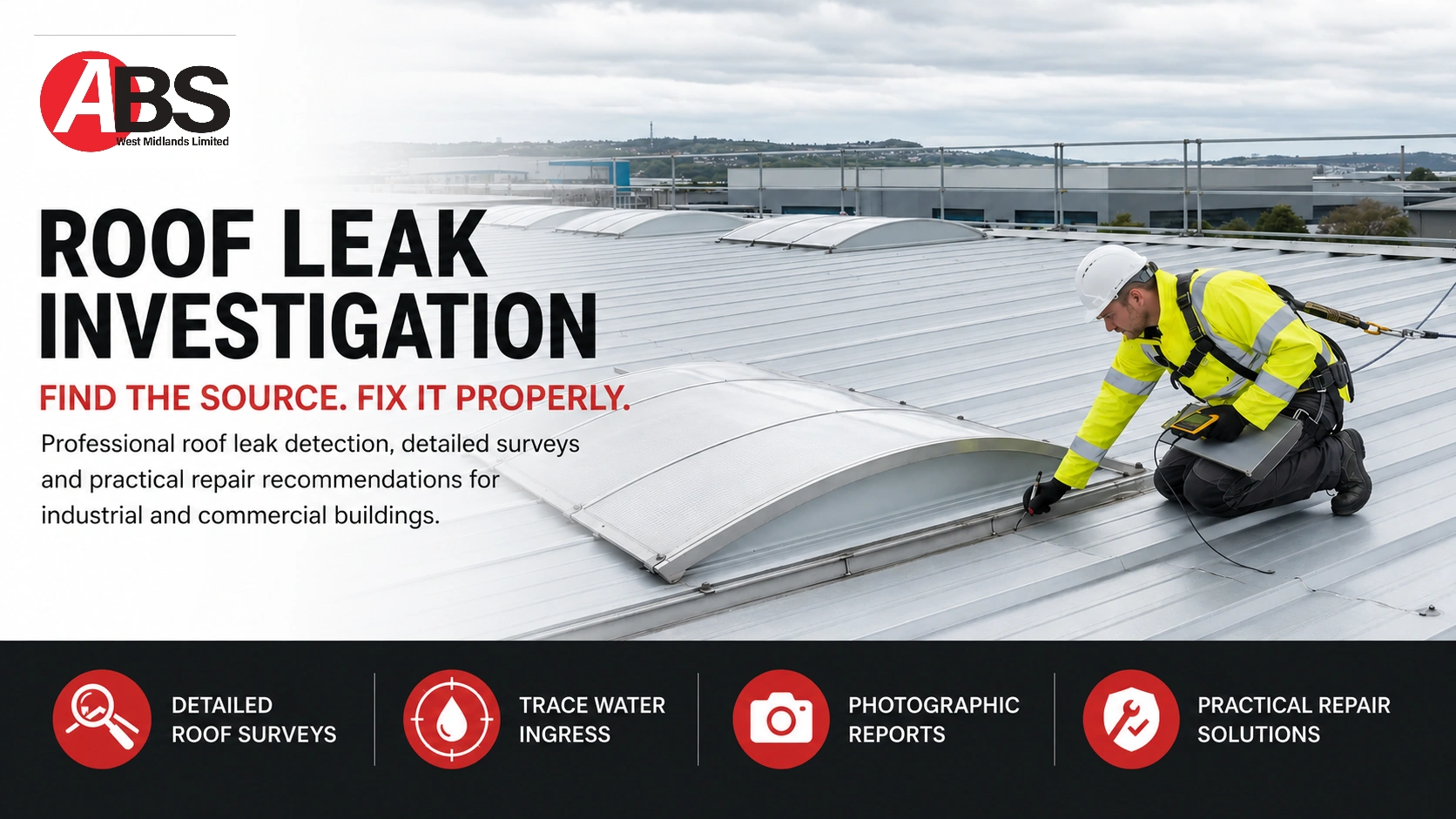
ABS Cladding Services carries out roof leak investigations and industrial roof inspections on warehouses, factories, distribution centres, retail units, offices and healthcare buildings. We work on commercial and industrial buildings only. With over 40 years’ experience in industrial roofing and cladding, we find where water is really getting in, show you with photographs and recommend a repair that lasts. Free leak inspections are available, and we can often attend at short notice.
Water ingress can be difficult to diagnose because a leak does not always show up directly beneath the point where water gets in. Rainwater can travel along roof sheets, insulation, structural steelwork, purlins and internal linings before it becomes visible inside the building. That is why a detailed roof leak investigation is essential before any repair work begins.
Our experienced surveyors inspect the whole external building envelope to trace the most likely source of water ingress. This includes the roof covering, rooflights, gutters, outlets, flashings, penetrations, fixings and cladding interfaces. By looking at the whole roof area, we can tell the visible symptom apart from the defect that is causing the leak.
Our professional roof leak investigation service
Every roof leak investigation begins with a review of the reported water ingress. Where possible, we speak with the facilities manager, building occupier or maintenance team to find out when the leak occurs, how often it appears and whether wind direction or heavy rain makes a difference.
We then complete a systematic external inspection of the relevant roof area and adjoining details. This may involve examining the roof covering, sheet end laps, side laps, fixings, rooflights, penetrations, gutters, outlets, flashings and vertical cladding interfaces.
What our roof leak investigation covers
- Industrial roof leak investigations
- Commercial roofing inspections
- Water ingress diagnosis
- All commercial and industrial roof types, including profiled metal, composite panel, built-up, flat roofing and asbestos cement roofs
- Rooflight and roof sheet assessments
- Gutter and rainwater system inspections
- Cladding interface inspections
- Ridge, verge and flashing assessments
- Roof penetration inspections
- Condition checks on roof safety lines and fall restraint systems, where fitted
- Photographic survey reports
- Short-notice inspections for active leaks
- Repair and refurbishment recommendations
- Planned preventative maintenance advice
We adapt each inspection to the building, the roofing system and the reported problem. We do not rely on a single standard repair, because industrial roof leaks can have several different causes and each roofing system must be assessed on its own merits.
Industrial roof inspection
An industrial roof inspection gives you a clear picture of the whole roof, not just the area that is leaking. We check the roof covering, rooflights, fixings, sheet laps, ridges, verges, flashings, gutters, outlets and the junctions with wall cladding. We also look for early signs of trouble, such as cut-edge corrosion, failing sealants and blocked outlets, so that small defects can be put right before they become leaks.
Our inspections cover all commercial and industrial roof types, including asbestos cement roofs. Every inspection comes with a photographic survey report that sets out what we found, where it is and how urgent it is. Facilities managers can use the report to plan work, compare options and brief landlords or insurers. If you need a full condition survey of a roof or a building’s cladding, see our industrial roof and cladding site surveys.
Commercial roof leak detection: how we trace the source
Finding the source of a leak on a commercial roof is rarely as simple as looking above the drip. We work through each leak step by step:
- Listen to the site team. We find out when the leak appears, how often, and whether wind direction or heavy rain makes a difference.
- Inspect inside. Where it is safe to do so, we look at staining, wet insulation and the point where the water shows.
- Inspect the roof. We check every likely entry point up the slope and around the area, including laps, fixings, rooflights, penetrations, gutters and flashings.
- Rule out condensation. Some “leaks” are actually condensation, which needs a different solution.
- Report and recommend. We give you photographs, the most likely cause and a clear recommendation, with the most urgent items first.
Common causes of industrial roof leaks
Industrial and commercial roofing systems are exposed to changing temperatures, severe weather, natural movement and long-term ultraviolet exposure. Over time, these conditions can affect sealants, protective coatings, fixings and junction details.
Common defects identified during a roof leak investigation include:
- Failed sealants at roof sheet end laps
- Cut-edge corrosion and coating deterioration
- Loose or incorrectly installed roof fixings
- Perished or compressed sealing washers
- Cracked, damaged or deteriorated rooflights
- Failed seals around roof penetrations
- Damaged ridge and verge flashings
- Defective cladding-to-roof interfaces
- Corroded or leaking valley gutters
- Failed gutter joints and previous temporary repairs
- Blocked outlets, downpipes and drainage systems
- Standing water caused by restricted rainwater flow
- Damaged composite panels or roof sheets
- Poorly installed patch repairs
- Condensation mistaken for external water ingress
Several defects can sometimes contribute to the same internal leak. A thorough roof leak investigation considers how water moves across and through the whole roofing system, rather than concentrating only on the point where the water shows inside.
Why accurate water ingress diagnosis matters
Repeatedly applying sealant around the internal leak area rarely solves the problem if the real entry point is further up the roof slope. Temporary repairs can also hide the original defect, which makes future diagnosis harder and creates more work later.
A professional roof leak investigation provides a structured assessment of the affected area. It helps establish whether the problem is local or part of wider deterioration across the roof.
Accurate diagnosis can help to:
- Prevent unnecessary repair work
- Reduce repeat callouts and temporary patching
- Protect stock, machinery and internal finishes
- Limit damage to insulation and roof components
- Identify developing defects before they get worse
- Support planned maintenance
- Extend the service life of the roofing system
Identifying the correct cause early means remedial work can be properly specified and prioritised.
Rooflight, fixing and sheet lap inspections
Rooflights are a frequent source of reported water ingress on older industrial buildings. Ageing rooflights can become brittle, discoloured or damaged, and the seals and surrounding laps can deteriorate through movement and long exposure to the weather.
During the roof leak investigation, we examine the condition of the rooflights and their connections to the surrounding roofing system. We also inspect nearby fixings, sheet laps and sealing details, because water that gets in at a nearby defect can travel beneath the roof covering before it appears inside around the rooflight. Dirty or moss-covered rooflights can hide cracks and failed seals, so industrial rooflight cleaning is often worth doing at the same visit.
Metal roof sheets and composite panels can also deteriorate around exposed edges, end laps and fixing positions. Cut-edge corrosion can develop where moisture gets beneath the protective coating. If it is left untreated, the coating can keep peeling away and the corrosion can spread across the sheet.
Our findings will show whether the affected components need local repairs, an end lap treatment, replacement fixings, protective coatings or full replacement.
Gutter and rainwater drainage assessments
Where they are relevant to the reported leak, we include valley gutters, boundary gutters, external gutters, outlets and downpipes. Blocked drainage can cause rainwater to back up and rise above gutter joints, welds, lining terminations and roof sheet overhangs.
Corroded gutter sections, failed joints and deteriorated sealants can also let water into the building. These problems may only show during prolonged or heavy rain, which can make the cause seem intermittent.
Where we find defects, we may recommend gutter cleaning, joint repairs, outlet improvements, replacement sections or a waterproof gutter lining system. Planned industrial gutter maintenance can also reduce the risk of future blockages and water ingress. Our guides on whether to replace or line an industrial gutter and cleaning industrial gutters before winter explain the options in more detail.
Photographic survey reports
After the roof leak investigation, you receive a detailed photographic report explaining the areas we inspected, the defects we found and the remedial work we recommend.
The photographs let facilities managers, building owners and contractors see areas that cannot be viewed safely from the ground. Our reports are written in plain English and, wherever possible, separate urgent defects from longer-term maintenance recommendations.
A typical report may include:
- Project and building information
- A description of the reported water ingress
- Details of the roof areas inspected
- Photographs of relevant roofing defects
- An explanation of the likely cause of the leak
- Recommended repairs and remedial solutions
- Priority ratings
- Longer-term maintenance recommendations
- Access and safety considerations
You can use the report to compare repair options, plan maintenance and support discussions with landlords, insurers or other responsible parties.
Safe access
We consider all access requirements before the roof leak investigation begins. Depending on the height, construction and condition of the building, suitable access may include a mobile elevating work platform, scaffold tower, fixed roof access system or other appropriate arrangements.
Industrial roofs and rooflights may be fragile, so safe working procedures and suitable fall protection are essential. We plan each inspection around the building and the areas that need to be inspected. Where buildings need permanent protection, we also install roof safety lines and fall restraint systems.
From diagnosis to repair, refurbishment or PPM
Once the cause of the leak has been identified, ABS Cladding Services can recommend a suitable remedial solution based on the condition of the roof. Recommended work may include:
- Replacement or upgrading of roof fixings
- End lap cleaning and waterproof treatment
- Cut-edge corrosion treatment
- Rooflight replacement or refurbishment
- Ridge, verge and flashing repairs
- Repairs around roof penetrations
- Gutter cleaning and outlet clearance
- Gutter joint repairs or waterproof lining
- Replacement roof sheets or composite panels
- Local cladding repairs
- Protective coating systems
- Flat roofing repairs
- Wider industrial roof refurbishment
Our recommendations deal with the defect that is causing the leak, rather than covering up the visible symptom. Once the cause is clear, we can carry out the repair ourselves. If the roof shows wider wear, we may recommend industrial roof refurbishment. To stop leaks coming back, a planned preventative maintenance (PPM) programme keeps gutters clear and fixings, sealants and rooflights checked on a set schedule. For new buildings and extensions, we also provide new build roof and wall cladding installation.
Roof leak investigation for operational buildings
We understand that warehouses, factories and distribution centres often need to stay open throughout the inspection and any repair work that follows.
We arrange access with your site contact and take account of vehicle movements, production areas, stored materials and occupied spaces. Where we need to inspect inside, we work with you to keep disruption to a minimum and investigate the reported leak safely.
For multi-site clients, our photographic reports give a consistent record of roofing defects across several buildings. This helps facilities managers compare priorities, plan maintenance and reduce emergency callouts.
Why choose ABS Cladding Services?
- Over 40 years’ experience in industrial roofing and cladding
- Free leak inspections and short-notice inspections
- Photographic survey reports written in plain English
- Practical, clearly prioritised recommendations
- Experience across all commercial and industrial roof types, including asbestos cement and flat roofing
- One contractor for investigation, repair, refurbishment and PPM
- Clients include NHS Supply Chain, Asset Alliance and Unipart
We can stay involved after the investigation, completing the recommended work and giving you photographs of the finished repairs.
Where we carry out roof leak investigations
From our base in Wolverhampton, we carry out roof leak investigations across the Midlands and the North West, including Wolverhampton, Birmingham, Coventry, Manchester and Liverpool. We work with building owners, facilities managers, property managers and main contractors looking after single buildings or multi-site property portfolios.
Whether the problem is a single leak around a rooflight, recurring water ingress from a valley gutter or wider deterioration across an industrial roof, our team can inspect the building and recommend the right next step.
Roof leak investigation FAQs
Do you offer free leak inspections?
Yes. We offer free leak inspections, usually next day, for commercial and industrial buildings. Call 01902 653322 or email info@abswestmidlands.co.uk to arrange one.
What is the difference between a roof leak investigation and an industrial roof inspection?
A roof leak investigation traces the source of a specific leak. An industrial roof inspection looks at the condition of the whole roof, so that defects can be found and planned for before they cause leaks. We can do both in one visit.
Why is the leak not directly above where the water comes in?
Water often enters further up the roof and runs along sheets, purlins or insulation before it drips inside. That is why we inspect the whole area, not just the spot above the leak.
Do you inspect asbestos cement roofs?
Yes. Our inspections cover all commercial and industrial roof types, including asbestos cement roofs, and we use safe working methods suited to fragile roofs.
What do I get after the inspection?
You get a photographic survey report showing what we inspected, the defects we found, the likely cause of the leak and our recommended repairs, with the most urgent items first.
Book a free leak inspection
To arrange a free leak inspection for your commercial or industrial building, call 01902 653322 or email info@abswestmidlands.co.uk. We will talk through the problem, arrange a suitable time and explain clearly what we find. Our teams can then carry out the recommended repairs, so you can go from diagnosis to a watertight roof with one contractor.
Request a Site Survey Send an Enquiry
No obligation. Just tell us about your building and we’ll be in touch.
IPAF · PASMA · CSCS · CITB · KeeLine, Kingspan, Euroclad and Alwitra approved installer