
October is when the gutters on an industrial building start to earn their keep. Leaves come down, storms blow debris across the roof and the rain gets heavier. A gutter that coped all summer can overflow in one downpour once its outlets are partly blocked.
Over the past week we carried out planned gutter cleaning on two large NHS Supply Chain warehouses, one with ten gutter runs and the other with eleven. Here is what the work involved, what we found, and what building owners and facilities managers should be thinking about before winter.
What a planned gutter clean involves
On both sites the work was part of a planned preventative maintenance (PPM) programme. Each gutter run was cleared of silt, moss and debris, and the outlets and drainage points were cleaned so water can get away freely. On one site the high-level runs were reached with a MEWP (a mobile elevating work platform), and a flat roof area and its outlets were cleared as well.
Every run was photographed before and after cleaning. The client can see exactly what was done on each section without anyone from their team going up on the roof, and the photos give a record to compare against at the next visit.
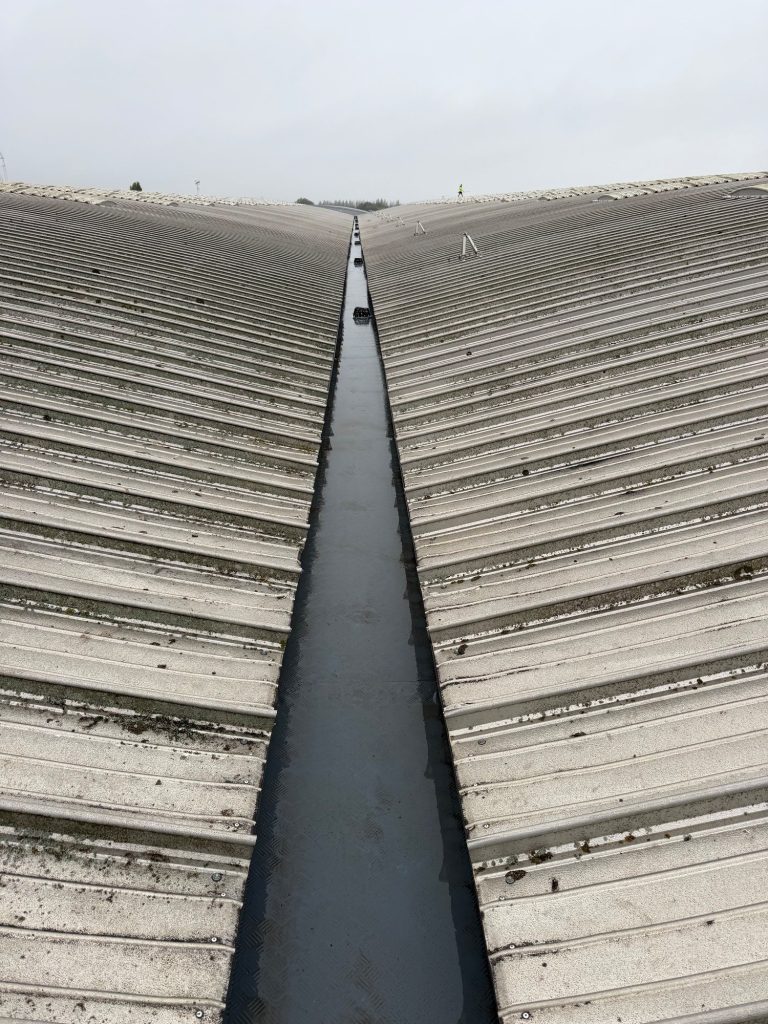
What we found
Most runs on both buildings were left in a satisfactory condition once cleaned. But cleaning is also the best chance to look properly at the gutter itself, because problems hidden under silt only show once it has been cleared. Three things stood out.
- Leaking joints. On one warehouse, the joints in one gutter run were leaking. We rated it as one to monitor and recommended resealing, with a check at the next visit. Caught now, that is a small repair. Left through winter, a leaking joint lets water track along the underside of the gutter and into the building, often some distance from where the leak actually starts, which is why leaks can be so hard to trace.
- Failed earlier repairs. On the other warehouse, joint repair straps fitted by previous contractors were lifting off and coming undone. Strap repairs can look fine from the ground, but once the edges lift, water gets underneath and the repair stops doing its job. We recommended re-sealing or replacing them as a planned repair.
- Water and debris with nowhere to go. On the first warehouse, the ends of the valley gutters have no proper discharge route, and birds on the roof are a constant source of feathers, droppings and nesting material. Earlier inspections had already recommended hoppers and downpipes at the gutter ends and bird netting across the whole roof, both rated urgent.
Those last two measures work together. Netting cuts down the debris at its source, and hoppers and downpipes give the water a controlled way off the roof. Doing one without the other only deals with half the risk, so we have recommended both go in before winter, with planned cleaning carrying on until they do.
Why autumn and winter are the risky months
Valley gutters collect water from two roof slopes at once. If an outlet blocks with leaves, debris or ice, the water level rises quickly and can spill over the back of the gutter and straight into the building. Add strong winds, heavy rainfall and freezing nights, and a gutter that is half full of silt is a leak waiting to happen.
Standing water does slower damage too. Water left sitting in a steel gutter speeds up corrosion, and once the metal starts to go, joints and laps are usually the first places to fail.
How often should industrial gutters be cleaned?
For most commercial and industrial buildings, at least twice a year: once in late autumn after the leaves have fallen and again in spring. Buildings near trees, or with a lot of bird activity, often need more, which is why the site above is staying on planned cleaning through autumn and winter. Putting it on a PPM schedule means it gets done at the right time, with a photo record every visit, instead of waiting for water to come through the ceiling.
When cleaning is no longer enough
If a gutter is rusting through, its joints keep failing or it holds standing water even when clean, cleaning only buys time. Gutter lining seals the existing gutter without the cost and disruption of replacing it. A Fatra single-ply lining comes with a 25-year warranty, and where a GRP lining suits the job better, that comes with a 5-year warranty. If you are not sure which state your gutters are in, a roof and cladding survey will tell you.
Book a gutter clean or inspection
We provide industrial gutter cleaning and maintenance nationwide for commercial and industrial buildings, and we can offer inspections at short notice. If you already have water coming in, we offer free leak inspections to find out where it is getting in and what it will take to fix.
To get your gutters booked in before winter, contact us or call us on 01902 653322.