
Industrial Roof Leaks: Why the Drip Is Rarely Where the Problem Is
When water comes through a warehouse roof, the natural reaction is to patch whatever is directly above the puddle. Sometimes that works. More often the leak comes back, or moves a few metres along, because the water was never getting in at that spot.
A proper roof leak investigation starts from the other end. It finds where the water is really getting in, then fixes that. Here is how we go about it, using a recent job for NHS Supply Chain at one of their North West distribution warehouses as an example.
Why leaks are hard to pin down
On a large industrial roof, water rarely drops straight down. Once it gets past the outer skin it can run along the roof sheets, purlins, insulation or steelwork before it finds a way out. A drip over a loading bay can start several metres away at a gutter joint, a flashing or a sheet end lap.
Wind matters too. Some leaks only show in driving rain from one direction. That’s why we always ask when the leak appears, how often, and in what weather.
A real example: ten leaks along the loading bays
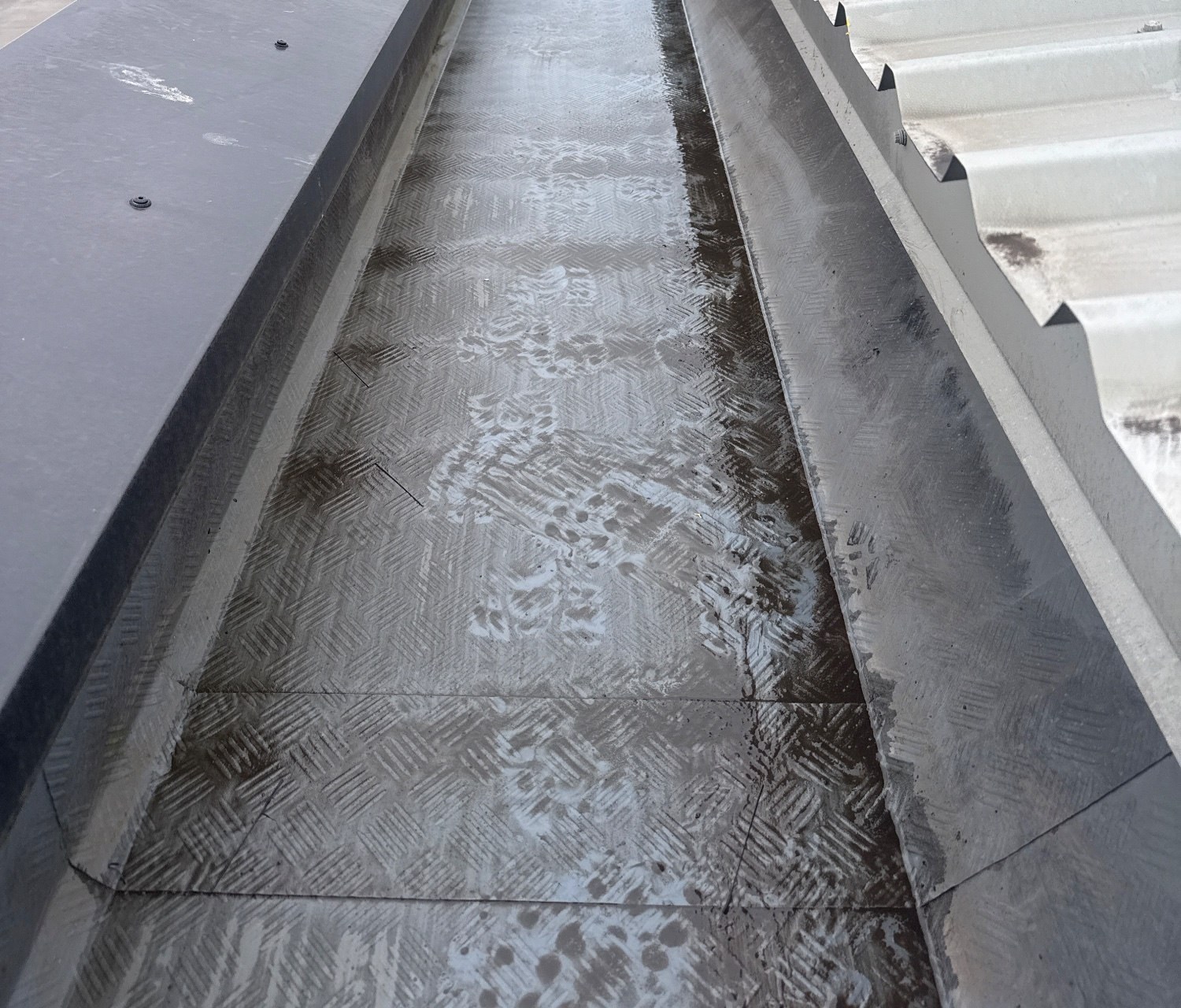
We first went to this site on planned gutter cleaning. While we were there we looked at a leaking joint in the membrane-lined gutter and found it had been fully welded, with no allowance for the gutter to expand and contract. As the temperature changed, the joint had nowhere to move, so it split. We repaired it with a new strap detail that allows for movement.
Later, the site called us back. There were now up to ten separate leaks reported along the loading bays, plus a new one at a valley gutter outlet.
Ten leaks could easily have meant ten call-outs and ten patches. Because we had already found one joint failing through movement, there was a good chance the same detail was repeated along the run. So we recommended surveying the full gutter runs from a MEWP and mapping every leak point, rather than chasing them one at a time. For the leaking outlet, the plan was to clear and test it, and if it ran clear, to check further down the drainage for a blockage that could be backing water up.
What the investigation found
Out on the goods-in elevation, the gutter itself turned out to be in reasonable shape. The joints were working and nothing was splitting. The problem was the flashing that closes the gutter off against the wall cladding.
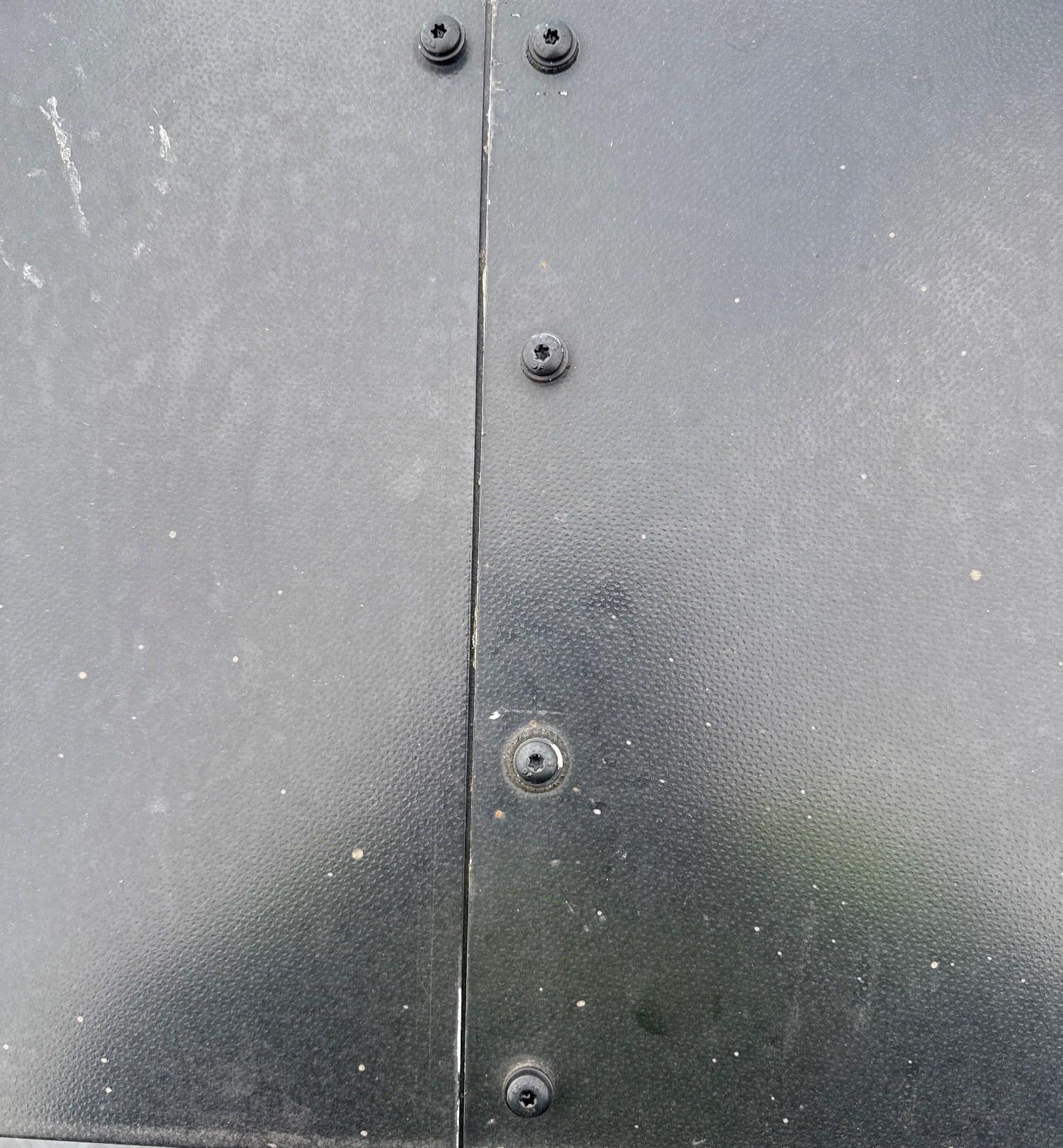
At each joint along that gutter line, the flashing was only fixed on one side. Worse, the fixings had spun in their holes, so they were no longer pulling the joint down tight. Every joint along the run was the same. Water was getting in through those open joints.
Patching the gutter would not have fixed that. The repair we recommended was to open up each flashing joint, replace the spun fixings, add fixings to both sides so the joints pull down tight, then reseal them. We rated it high priority with winter coming.
How we carry out a roof leak investigation
The approach is broadly the same on every building:
- Talk to the site. Where the water shows, when it started, and whether it’s worse in certain weather.
- Look from the ground first. A lot can be ruled out before anyone goes up.
- Inspect the whole area, not just the spot above the drip. That means gutters, outlets, joints, flashings, sheet laps, fixings, roof lights and the junctions where the roof meets the wall cladding.
- Check the drainage. A blocked outlet or downpipe can back water up and overflow inside, even when the gutter is sound.
- Photograph and report. You get a written report with photos, a clear priority for each defect and our recommended repair.
Common causes we find
The usual culprits are:
- gutter joints with no room for movement, or joints that have split
- blocked outlets and downpipes backing water up
- flashings that are under-fixed, lifted or have spun fixings
- sheet end laps with cut-edge corrosion
- old fixings with perished washers
- rusted-through steel gutters
Where a steel gutter has rusted badly, lining it is often better value than replacing it. We install liners under the roof sheets so water can’t get underneath them. A Fatra single-ply lining carries a 25-year warranty, and a GRP lining carries a 5-year warranty. There’s more on our gutter lining page.
Inspections and surveys
We offer free leak inspections from ground level, usually next day. If we need to get onto the roof to trace the leak properly, that’s a charged survey, and you’ll get a written report with photographs. You can read more about our roof leak investigation service and our roof and cladding surveys.
Regular planned maintenance visits are often when we spot a spun fixing or a failing joint before it becomes a leak.
We work across England and Wales, on warehouses, factories, logistics units, healthcare sites and offices.
Got a leak that keeps coming back?
If you’ve patched the same leak more than once, it’s worth finding out where the water is really getting in. Send us an enquiry with a few photos, or call us on 01902 653322.